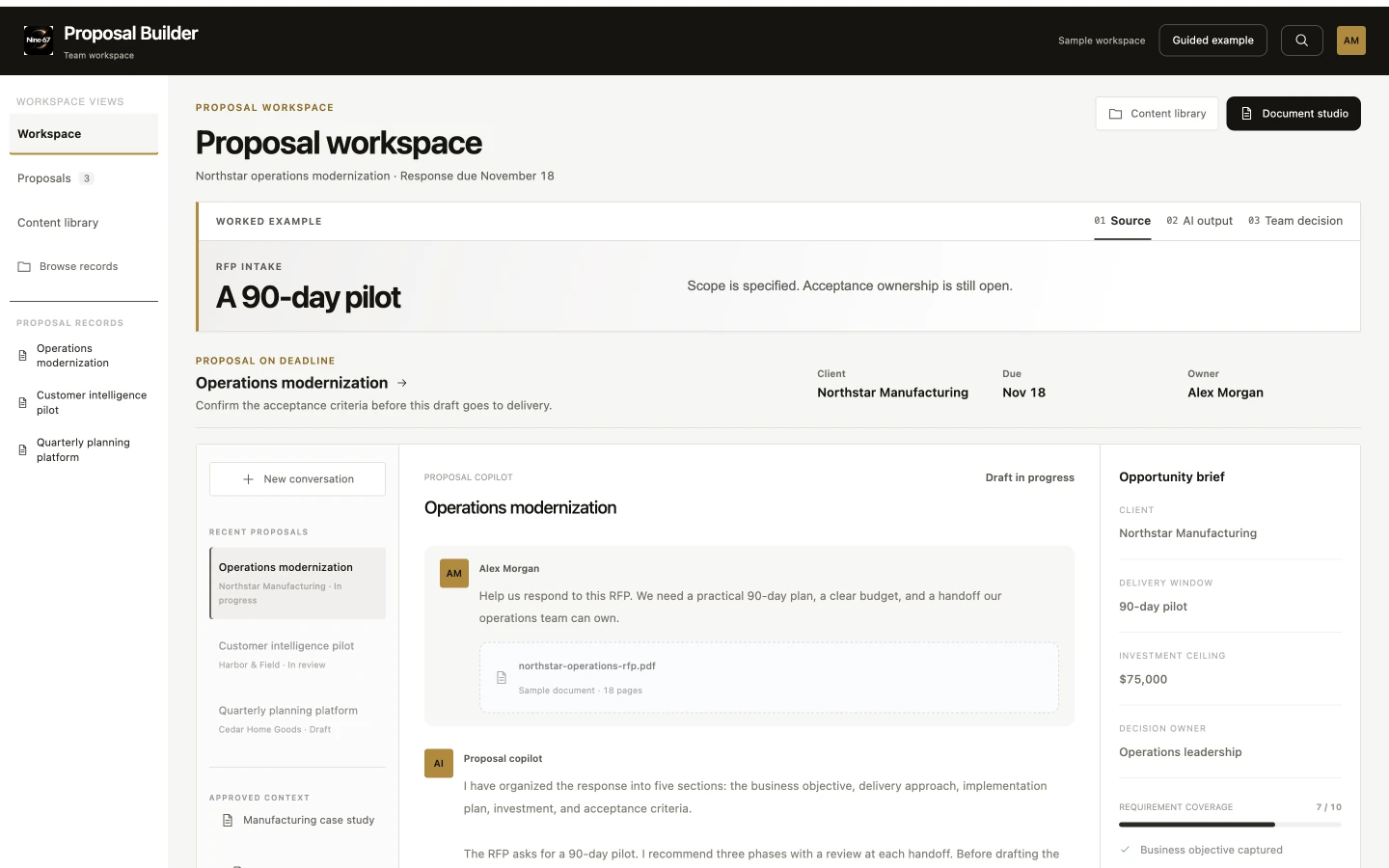
Most of your next RFP response has already been written. It sits in past proposals, case studies and team biographies. AI can find the relevant passages and assemble a first draft from them, so your experts spend their hours reviewing the argument and setting the price.
What a response costs today
An RFP, or request for proposal, is a buyer's formal invitation to bid. Loopio, which makes proposal software, surveys response teams every year. Its 2026 benchmarks, drawn from more than 1,500 teams, give the scale of the work:
- Teams spend an average of 33 hours on each RFP, down from 35 the year before.
- Nine people contribute to each response, a number that has held steady since 2021.
- 79% of teams now use generative AI in the process, up from 68%, and 62% use it to draft specific answers.
The same research names the constraint. For the first time, bandwidth is the top challenge for response teams, and submissions have risen to an average of 166 a year. More bids are going out, and each one still needs the same experts.
Where the hours go, and what changes
| Stage | Who is involved | What AI drafting does | What stays with your people |
|---|---|---|---|
| Reading the RFP | Proposal lead | Extracts every requirement and deadline into a checklist | Decide whether to bid |
| Finding past answers | Proposal lead, experts | Suggests approved passages that match each requirement | Choose which evidence fits this buyer |
| First draft | Writers, experts | Drafts each section from the chosen material, in your firm's voice | Rewrite the parts that carry the argument |
| Expert review | Partners, delivery leads | Flags requirements with no answer and claims with no source | Check every claim, credential and commitment |
| Pricing and terms | Partner, finance | Nothing: the draft leaves these open | Set the price, scope and terms |
| Assembly | Proposal lead | Formats the response in your template | Final read and sign-off |
Look at the right-hand column. The judgment stays where it was. What moves is the searching, the retyping and the formatting that used to come first.
What makes the draft good?
The draft is only as strong as the library behind it. Before any drafting starts, decide three things.
What counts as approved. Collect the proposals, case studies and biographies you are willing to reuse, and retire the rest. A draft built from a superseded service description creates work for the reviewer.
Who owns each part. Give every section of the library a named owner who keeps it current: the delivery lead for methodology, HR for biographies, finance for rates.
What a person must always write. Pricing, scope and any contractual commitment stay with a partner. The application leaves those fields open by design.
What happens to headcount?
Responsive and the Association of Proposal Management Professionals surveyed 726 revenue leaders and practitioners for their 2025 report. Among the companies surveyed, more than half of those using AI reported increasing headcount, compared with 27% of companies not using it.
How should you measure it?
Pick three numbers and record them for your last ten responses before you change anything:
- Total hours per response, from receipt to submission.
- Senior hours per response: the partners and experts whose time is scarcest.
- Requirements missed, counted at final review.
Then run your next five responses with AI drafting and compare. Win rate matters most in the end, and it moves slowly. These three tell you within a quarter whether your experts have their time back.
Where to start
Take one recent RFP you have already answered. Have the application draft a response from your approved library, and ask the partner who led the original to compare the two. The gaps they find show you what the library is missing, and that list is your first month of work.
Sources
- Loopio: Average RFP Win Rates and More, 38 Proposal Statistics to Know in 2026
- Loopio: 2026 RFP Response Trends and Benchmarks Report
- Responsive: 2025 State of Strategic Response Management Report
See what we would build for your business. Book a meeting